【Client Story】 “Let Me Struggle Until I Get It” — How Dr. Ariel Thorpe Built Business Japanese Around Her Tokyo Clinic
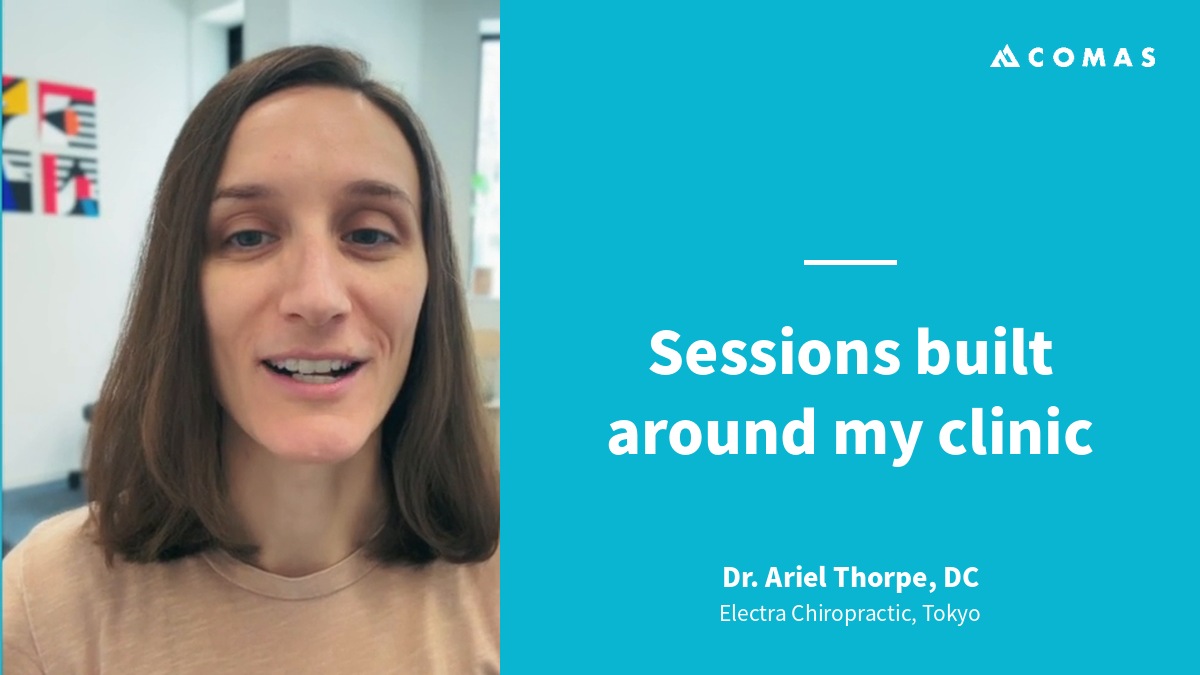
Most language providers sell you a curriculum. Dr. Ariel Thorpe wanted something narrower and harder to deliver: a trainer who would stay quiet.
“What I really need from an instructor is somebody to just sit there in silence and let me struggle until I get it.”
Ariel is a chiropractor. Originally from the U.S., where she trained, she grew up in Hong Kong and now runs Electra Chiropractic in Tokyo. Her Japanese isn’t a credential she’s collecting. It’s the language her patients book in, describe symptoms in, and ask questions in.
It started with a survey, not a placement test
Before any session was scheduled, Ariel filled out an intake survey covering what she wanted from the program and how her business worked.
“So I filled out an initial survey about what I was looking for from the program, a little bit about my business.”
COMAS then recommended a specific trainer, Kumiko, rather than assigning whoever was available. That distinction matters more than it sounds. It also came with a follow-up most providers never make:
“So they asked, are you good with this tutor? Do you want to try some others?”
Her answer was no.
“And I was perfectly happy with her.”
Her trainer had read up on the clinic before they met
The first session did not begin with an explanation of what a chiropractor does.
“She had done so much research ahead of meeting me.”
For a practitioner, this is the difference between generic business Japanese and usable Japanese. Vocabulary for a clinic isn’t vocabulary for a sales meeting. Ariel returns to this point at the end of the interview when she considers whether the approach would transfer:
“Based on my experience of how well prepared my tutor was with working with my specific business, I’m pretty sure they would be prepared for any type of business.”
▶ See how COMAS builds programs around each learner’s actual work: our language program
Being handed the word doesn’t teach you the word
This is the heart of her story, and it’s a real pedagogical position rather than a compliment.
“It takes me so long to pull the word or the sentence out from my memory. And in the past I have had experiences where the other person is feeding me the word, and that doesn’t help me actually learn that word. That helps me rely on them to know the word.”
Supplying the word ends the silence and feels like help. It also removes the retrieval effort that makes the word stick. Ariel had experienced the alternative and knew what it cost her.
“So I appreciate that she just lets me struggle when I need to struggle.”
Note the qualifier. Not always — when she needs to. Knowing which silences to hold and which to break is trainer judgment, and it doesn’t come from a curriculum.
Progress she couldn’t feel, measured anyway
Ariel is candid that her own read on her progress is unreliable and pessimistic.
“Especially because to me, I just think I am not improving at the rate that I should be.”
Two things counter that. Her trainer names the improvement directly:
“And yet she’s very encouraging. And she does point out that yes, indeed, my Japanese has improved.”
And the program retests her on a schedule, so the judgement isn’t only subjective:
“A program like COMAS allows you to do these regular check-ins where you’re being retested, and you can see, okay, there is some progress in whatever area you’re working on.”
By her own account the change shows up in three specific places: she is speaking faster, formulating sentences quicker, and using a broader vocabulary. Those are the things a learner notices in a real conversation, not on a score report.
▶ Wondering where your Japanese actually stands? Talk to us about an assessment
Twice a week, rescheduled around a clinic that overruns
Ariel trains twice a week. She also runs a practice, which means the schedule breaks.
“My schedule is a little bit all over the place, so I frequently have to reschedule and do makeup sessions.”
Then the honest part:
“Which, if I was relying on studying on my own, it simply wouldn’t happen.”
Accountability is the product
Asked why she pays for this rather than self-studying, she doesn’t reach for anything about materials or method.
“I personally need that accountability. I need to pay someone to keep me on track and to check in on my progress as well.”
Self-study assumes a learner who reliably shows up for themselves after a full day of patients. Ariel’s position is that she isn’t that person, and that paying for structure is the rational response rather than a failure of discipline. It’s a more useful thing to say out loud than most testimonials manage.
Would she recommend it?
“I would recommend that anyone check them out and see if it fits their needs.”
Measured rather than effusive — which, from someone this specific about what she wanted, carries more weight than enthusiasm would.
▶ If you need Japanese for the work you actually do, see our language program or get in touch through our inquiry form.
Learner profile
| Name | Dr. Ariel Thorpe, DC |
| Business | Electra Chiropractic, Tokyo |
| Background | Trained in the U.S., raised in Hong Kong |
| Target language | Japanese |
| Format | Twice weekly, with makeup sessions |
| Trainer | Kumiko |